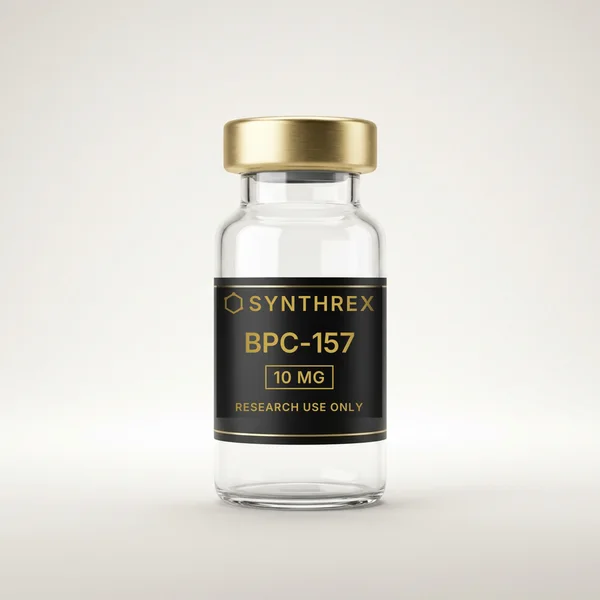
BPC-157
COA published
A synthetic pentadecapeptide studied in in-vitro models of tissue-repair signalling and cellular migration.
From$54.00Select size
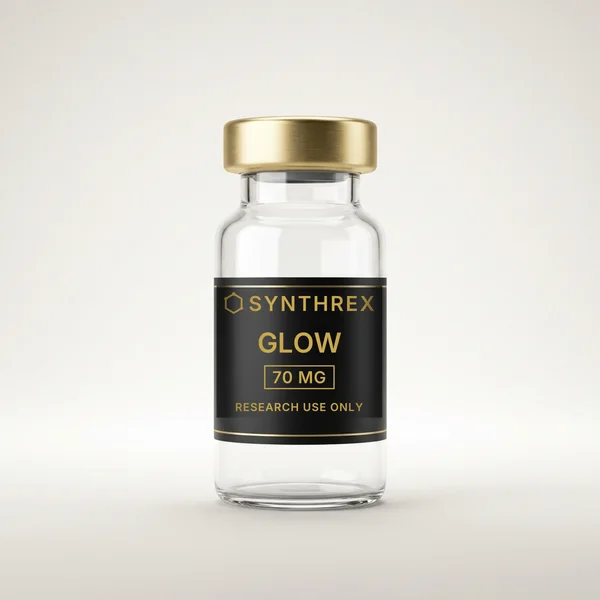
Cytoprotective
A combined BPC-157, GHK-Cu and TB-500 preparation studied in dermal and repair research contexts.
Select size
Quantity
Total
$89.00
That's the price. No inflated list, no permanent “discount” code to make it look cheaper than it is.
COA pending. The certificate for this lot will be uploaded to our COA library as soon as we have it.
Have a question?
For research use only. Not for human consumption.
Products supplied by Synthrex Biotech LLC are intended strictly for in-vitro laboratory research and development by qualified professionals. They are not drugs, foods, cosmetics, or dietary supplements, and are not approved by the FDA for human or veterinary use. They are not sold for, and must not be used for, human or animal consumption or administration of any kind. Synthrex Biotech LLC is not a compounding pharmacy or chemical compounding facility as defined under section 503A of the Federal Food, Drug, and Cosmetic Act, and is not an outsourcing facility as defined under section 503B of that Act. By purchasing, you affirm that you are a qualified researcher acquiring these materials for lawful research purposes only. A Safety Data Sheet (SDS/MSDS) is available on request for every compound.
Sold by Synthrex Biotech LLC. A Safety Data Sheet (SDS) is available on request at support@synthrexbiotech.com.
A co-formulation of three separately characterised compounds — BPC-157, the copper tripeptide GHK-Cu (identified in human plasma by Loren Pickart in 1973), and TB-500. The blend is a supplier formulation, not a molecule described in the literature, and has no discovery history of its own.
Each constituent has been characterised independently and by an unrelated mechanism: GHK-Cu as a copper(II)-binding tripeptide studied in dermal and fibroblast cell-culture models, BPC-157 in rodent angiogenic and cytoprotection models, thymosin beta-4 as a G-actin sequestering peptide in vitro. There is no published characterisation of this three-component combination as a single entity. Anything asserted about the blend is extrapolated from the separate component literatures. None of the three is FDA-approved for human use.
These notes are provided for scientific context only. They describe published laboratory and preclinical research and are not a claim of any effect in humans. These statements have not been evaluated by the Food and Drug Administration. This product is not intended to diagnose, treat, cure, or prevent any disease. Summaries of published literature for research reference only. Not a claim about any product’s effect.
BPC-157 traces back to a question asked at the University of Zagreb in 1975: if the stomach lining survives its own acid, does gastric juice contain something protective? Predrag Sikirić assembled a team in 1981 that collected human gastric juice from hospital gastroenterology clinics and screened the fractions for protective activity. In 1989 the group reported isolating the active fragment, and the synthetic pentadecapeptide was formally described in 1993. It is a 15-amino-acid sequence — Gly-Glu-Pro-Pro-Pro-Gly-Lys-Pro-Ala-Asp-Asp-Ala-Gly-Leu-Val, molecular weight 1419.55 Da — derived from a larger protein found in gastric juice. Unusually for a peptide, it is stable in human gastric juice, which is why the original work was possible at all.
The published literature characterises BPC-157 in animal and in-vitro models as a cytoprotective agent, with reported activity on angiogenic signalling (VEGFR2 pathway), nitric oxide system interaction, and growth-factor expression in gastrointestinal and connective tissue models. The great majority of this work is preclinical — rodent and cell-culture studies. It has not been approved by the FDA for any human use, and human clinical data remains extremely limited.
GHK is a naturally occurring tripeptide — glycyl-L-histidyl-L-lysine — identified in human plasma by Loren Pickart in 1973. Pickart was studying why plasma from young donors behaved differently from plasma from older donors in liver-cell cultures, and isolated GHK as the active factor. The copper complex GHK-Cu followed once it became clear that the tripeptide binds Cu(II) with high affinity at physiological pH, and that the copper is integral to its behaviour rather than incidental. It is one of the few compounds in this catalog with a genuinely long and independently replicated literature.
Characterised as a copper(II)-binding tripeptide. The copper coordination is the mechanistic centre: GHK-Cu acts as a copper carrier, and much of the described activity in fibroblast and dermal cell-culture models concerns copper-dependent enzyme systems and extracellular-matrix gene expression. Recent work has examined the complex in a rodent silicosis model targeting peroxiredoxin 6, and studied GHK-hyaluronan conjugates for antioxidant and osteogenic/angiogenic properties in vitro. Preclinical and in-vitro throughout. Not FDA-approved as a drug; the tripeptide appears in cosmetic formulations under separate regulatory rules.
TB-500 is a synthetic fragment of thymosin beta-4 (Tβ4), a 43-amino-acid peptide originally isolated from bovine thymus tissue. Its complete amino acid sequence was published in the Proceedings of the National Academy of Sciences in 1981, following work through the 1960s and 70s on biologically active thymus extracts — at that point it was understood as a thymic hormone and studied for its effect on thymocyte populations. The reframing came later, when Tβ4 was identified as a major G-actin sequestering protein. That reclassification, from immune factor to regulator of the cytoskeleton, is the reason the compound appears in tissue-repair literature at all.
Thymosin beta-4 is characterised as a principal G-actin sequestering peptide in mammalian cells: it binds monomeric (G-)actin and influences the balance between free monomer and polymerised filament, which governs cytoskeletal remodelling and cell migration. Later work has examined it as a target of hypoxia-inducible nitric oxide and HIF-1α regulation in cell-culture models. All of this is preclinical and in vitro. TB-500 is not FDA-approved for human use, and thymosin beta-4 is on the WADA Prohibited List.
These statements have not been evaluated by the Food and Drug Administration. This product is not intended to diagnose, treat, cure, or prevent any disease. Summaries of published literature for research reference only. Not a claim about any product’s effect.
Batch releases & restocks
Every certificate is published and available for review. Join the Lab List and we'll tell you when a new one lands and when a sold-out compound is back — plus 15% off your first order, shown on screen the second you join.
Batch and restock notices from Synthrex Biotech LLC. No dosing advice, ever. One-click unsubscribe on every email.
COA published
A synthetic pentadecapeptide studied in in-vitro models of tissue-repair signalling and cellular migration.
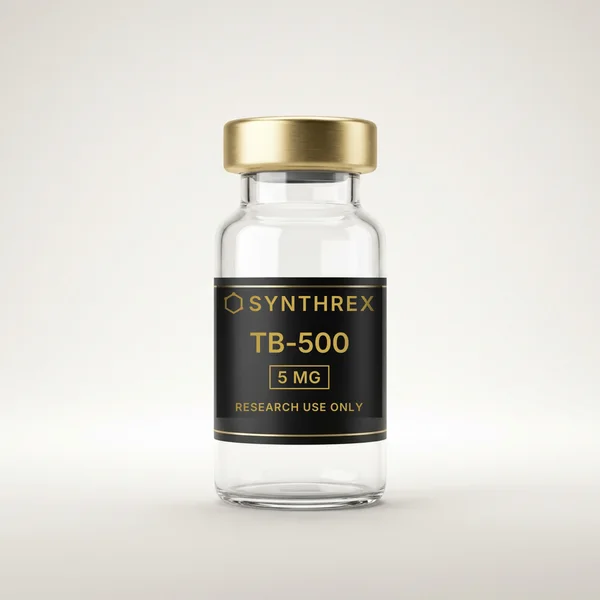
COA published
A thymosin beta-4 fragment investigated in research on cellular migration and angiogenesis pathways.
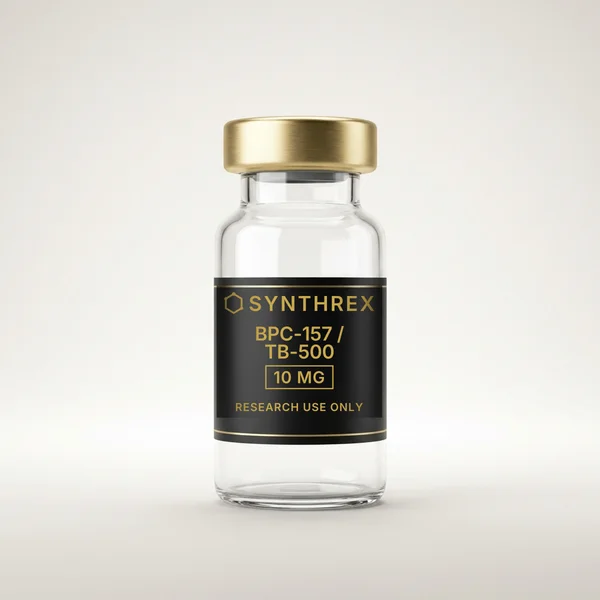
COA published
A combined preparation of BPC-157 and TB-500 used in comparative tissue-repair research models.
These statements have not been evaluated by the Food and Drug Administration. This product is not intended to diagnose, treat, cure, or prevent any disease.